Talent as a Loop, Not a Gift
The talent debate has always fascinated me. In my previous posts, I tried to challenge the myth that talent must come from natural gifts. But I’ve realized something: the nature vs. nurture debate might not be the problem to solve—it might be the wrong question entirely.
Asking “Do I have talent?” traps you. It’s a binary question with no good answer. You’re waiting for a verdict on something you can’t measure. Am I talented enough? How would I know? It leads to paralysis or false confidence, neither of which helps you actually develop.
So let me propose a different question: “Can I build the conditions where I thrive?”
This shift changes everything. Instead of searching for talent as some hidden essence inside you, you start building talent as a functional system. And the core of that system is surprisingly simple: a positive reinforcement loop.
The Positive Reinforcement Loop
In Mastery, Robert Greene describes Charles Darwin’s transformation during his voyage on the HMS Beagle:
“As the journey progressed, Darwin noted some obvious changes in himself. He used to find almost any kind of work boring, but now he could labor all hours of the day; in fact, with so much to explore and learn he hated wasting a single minute of voyage. He had cultivated an incredible eye for the flora and fauna in South America. He could identify local birds by their songs, the markings on their eggs, their manner of taking flight. All this information he could catalog and organize in an efficient manner. More important, his whole way of thinking had changed. He would observe something, read and write about it, then develop a theory after more observation, the theories and observations feeding off one another. Full of details about so many facets of the world he was exploring, ideas were sprouting up out of nowhere.”
Darwin went from finding work boring to hating wasted time. From passive to obsessed. From following instructions to generating ideas. What happened?
He entered a loop.
You’ve probably heard both of these ideas: the “10,000 hours rule” to achieve mastery, and the wisdom to “find a profession you love and you’ll never work a day in your life”.
They sound contradictory. One says grind hard enough and you’ll succeed. The other says find your passion, and success will feel effortless. But they’re actually pointing at the same underlying truth: to become really good at something, you need to practice a lot. And to practice a lot, it has to feel frictionless.
When you genuinely enjoy something, practice doesn’t feel like a burden. It becomes automatic. If you have spare time, it’s one of the first things that comes to your mind. You find yourself seeking it out. That’s the moment the loop starts.
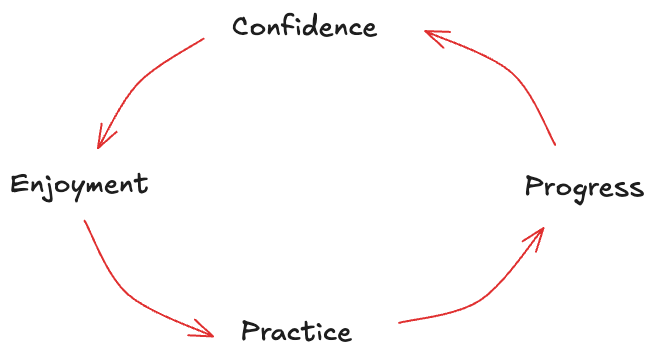
This is it. This is the mechanism. And it’s also the measure of potential.
In the old “talent” language (which I want to abandon), you’d say someone is talented because they can sustain this loop. And sustaining the loop makes you more talented. The two are inseparable.
The Easiest Path (But Not The Only Path)
I mentioned enjoyment first because it is the easiest way to enter the loop. You start an activity, you have fun doing it, and you naturally want to do it again. The conditions practically build themselves.
But—and this is crucial—that’s the easiest path, not the only path.
Your journey to the loop can look completely different from someone else’s. Most commonly, people do experience it the “easy” way: enjoyment comes first, then practice follows naturally, then competence arrives as a result. But there’s another way that works too: deliberate effort → small wins → confidence → enjoyment.
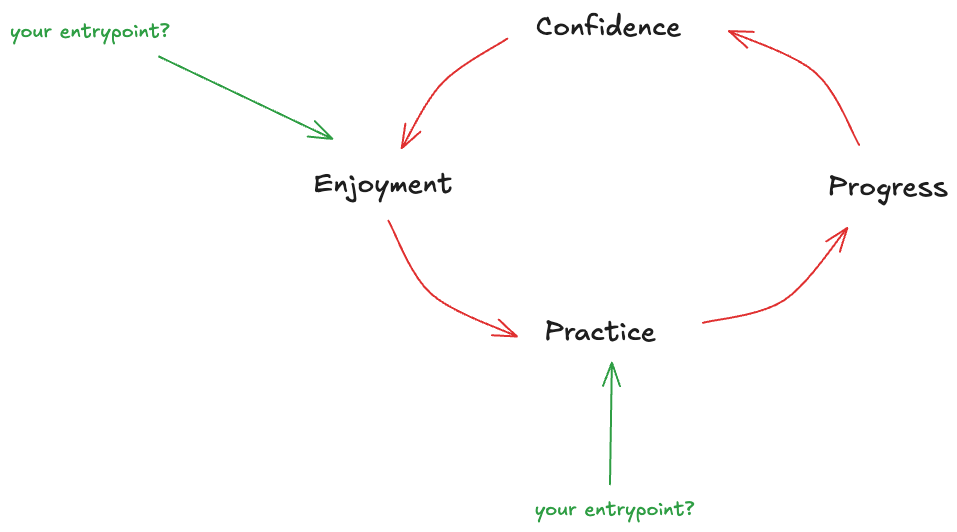
You start not because you love it, but because you have to. Or because you’re pragmatic. You gain some competence through work or practice. Then something shifts. When you realize you can actually solve problems, something clicks. Suddenly, you start looking for problems to solve. You want to improve. And that want—that enjoyment—emerges from the competence you already built.
Mindset Shift
Someone might argue: “Isn’t the ability to form a loop just talent by another name? You’re just rephrasing the same thing.”
The answer is no. Here’s the crucial difference:
-
Gift thinking: “Do I have the talent?” (passive, binary, waiting for validation)
-
Loop thinking: “Can I build the right context?” (active, variable, problem-solving)
Natural talent is fixed. The loop-forming ability is learnable and contextual.
You can lack obvious predispositions but still form a loop if you find the right environment, feedback, people, and approach. Someone without a head start can absolutely develop genuine talent by building the conditions. The mindset shift means moving from judging yourself to designing your conditions.
This is agency. This is actionable. This is why it matters.
Beyond Growth Mindset
You might recognize some of these ideas from Carol Dweck’s growth mindset framework. She taught us something revolutionary: effort and practice matter. You can develop ability through dedication and work.
That was important. But here’s what’s incomplete about it.
Growth mindset says: Keep trying harder.
The loop framework says: Try smarter. Find the right context(s).
Dweck shows us that effort matters. But this framework shows us where and how effort actually compounds into real development. It’s not just about willpower and pushing through. It’s about building a functional system where effort naturally sustains itself through enjoyment, feedback, and small wins.
Growth mindset can leave you exhausted, trying harder in the wrong context. The loop framework says: if effort isn’t compounding, redesign the system first.
My Story: Starting Without Love
This is where the framework comes to life.
I didn’t start by falling in love with programming. I hated it, actually. During my tech studies, I struggled constantly. I couldn’t solve problems. The logic didn’t make sense. I felt lost. So I concluded the obvious: “This isn’t for me. I don’t have talent for this.”
If the story had ended there, I probably would have quit forever. But it didn’t, for a practical reason: I had already invested years in tech studies, and software development was (and still is) a lucrative field. So I gave it another shot—partly out of sunk cost bias, partly out of pragmatism. I didn’t feel love for coding. I just thought: maybe a different approach would work.
Working part-time as a developer changed everything. I was solving real problems. Real bugs. Real systems. I was getting feedback from actual code running, not from grades or assessments.
Slowly, small competencies accumulated. I solved one problem, then another, then another. Each small win gave me confidence that I could do this. Competence brought confidence. And then—and only then—something unexpected happened: I started wanting to solve technical problems. I’d see a challenge and think about how to approach it. I’d explore how systems worked.
The loop had formed, but backwards from the cliché. Competence came first. Enjoyment followed. And now? I’d describe myself as a talented engineer—something I never would have said during my studies.
What This Proves
My story isn’t unique. It’s just evidence of a simple truth: You don’t need to start with passion. You don’t need to wake up and feel a magnetic pull toward your craft. Sometimes you start with pragmatism, necessity, or just the willingness to try differently.
But if you can build small wins and competence in the right conditions, the loop can still form. Enjoyment can arrive later. And once it does, you’re no longer waiting for talent to appear—you’ve actively built it.
The mechanism is the same. The entry point can be different. And that difference is everything for people who think they lack talent in something, when really they just haven’t found the right way in yet.
When to Persist, When to Pivot
Context Isn’t One Thing—It’s a Combination
Here’s something crucial: the loop needs multiple contexts to align. But that doesn’t mean you need all possible contexts to be perfect.
Different combinations work for different people. Maybe you don’t have money for formal training, but you have incredible grit and determination. Maybe you don’t have a coach, but you have supportive parents who believe in you. Perhaps you don’t have someone providing expert feedback, but you’re a strong analyst and can identify your own gaps.
This is fundamentally different from the fixed talent approach. Fixed talent says: “You either have this specific thing or you don’t.” The loop approach says: “What combination of contexts can work for you?”
There’s no single recipe. You work with what you have. You substitute what’s missing. You experiment with different combinations until something clicks.
But—and this is the hard part—your resources are still limited.
Searching vs. Investing
You can create a setup. You can improve it. You can wait. And sometimes, despite all that, it still doesn’t help. The loop doesn’t form. It’s probably not for you. It might be time to pivot.
This is the paradox that everyone faces: How do you balance investing deeply in one domain versus searching broadly for the right domain?
The contradiction is real:
-
Too broad a search = you never stay long enough for a loop to actually form
-
Too narrow a focus = you might miss your real domain entirely
Either extreme wastes your limited resources—time, energy, money.
Sometimes sunk cost bias keeps you stuck in a choice, and it pays off later. (This was me with coding.) Sometimes it’s just wasted time. No algorithm tells you which is which.
When The Loop Doesn’t Click
When you’ve tried, adjusted, and the loop still isn’t forming, you have two equally valid options:
-
Adjust strategy and context. Try different environments, different mentors, different approaches. Give yourself more time, but with different strategies—the loop might form under different conditions.
-
Try something entirely different. If you’ve genuinely tried to build supportive contexts and nothing is clicking, this might not be your domain. This isn’t failure—it’s information.
Neither option is wrong. Both are strategic.
Sometimes persistence is exactly what you need—and you’re one context adjustment away from the loop forming. Sometimes persistence is the problem—and you need permission to move on.
The honest truth? You won’t know for certain which it is until you look back later. But you can make better bets by asking the right questions and being honest about what you’re seeing.
Sometimes what keeps you near the possibly-forming loop—supportive parents, sunk cost bias, external pressure—is exactly what you need to stay long enough. Sometimes it’s what traps you in the wrong place.
The wisdom isn’t in knowing the answer in advance. It’s in staying honest about whether the conditions are improving, whether small signs of progress are appearing, and whether you’re actively building toward the loop or just hoping it happens.
That’s the best you can do. And sometimes, that’s enough.
Sustaining and Developing the Loop
When we create a loop, we care about finding love for the activity. In later stages, we care about not losing that love—especially to burnout.
Sometimes we think that once something becomes real and established, it should be stable and uniform. If it needs to evolve, something must be wrong. But I think that’s a false conviction. The same applies to the loop. As your craft or skill develops, the loop takes slightly different forms, and different aspects need attention to keep it healthy.
I propose three stages of skill development, each requiring a different approach: Beginner, Apprenticeship, and Mastery.
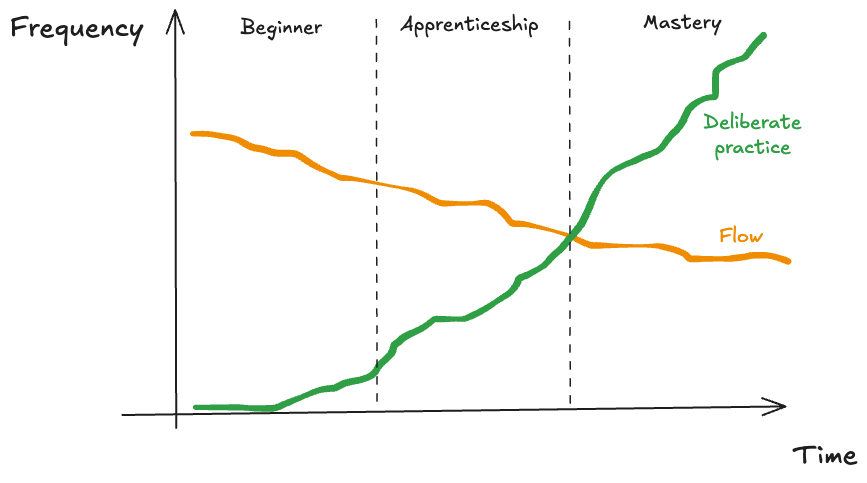
Stage 1: Beginner (Play and Flow)
Lots of play, exploration, and flow. You don’t need to be good yet—you just need to enjoy it enough to keep going. Small wins matter enormously. Did I do that? I did that!
You’re at the beginning of the path, so proper practice brings fast effects. The loop circulates rapidly. Progress feels visible. This is where you fall in love.
Stage 2: Apprenticeship (Guided Development)
You’ve gained some competence. But it’s not so easy to improve just by flowing anymore. You need guidance.
At this stage, a mentor or coach becomes invaluable. They provide feedback, support when you’re stuck, and help you see blind spots you can’t identify yourself. The loop is still there, but now it needs structure to keep circulating. You’re building skill, but you must protect the enjoyment from becoming pure grinding.
Stage 3: Mastery (Experimentation and Deliberate Practice)
You push toward excellence and a kind of uniqueness. Enjoyment is often traded for satisfaction—the satisfaction of solving hard problems in ways that are yours.
Development needs to be carefully directed now. You drill when you see weakness. Deliberate practice can be self-directed, but also be supported by a mentor if you can find someone who can help at this level. Your competence is high, so you experiment. You try to find a totally new way—your way.
Even here, you must not completely lose the enjoyment. It keeps you going through the hard parts. Burnout is the real threat at this stage.
Different Stages, Different Strategies
Here’s what many people don’t understand: the same strategies don’t work across stages.
If you treat Stage 2 like Stage 1, you’ll never push past beginner level. You need structure. You need a mentor. If you try to keep Stage 3 like Stage 2, you’ll never develop your own voice—you’ll be forever following someone else’s path. If you return to Stage 1 approaches during Stage 3, you’ll lose momentum. You’ve moved past play. You need strategic direction now.
The loop is constant. But what sustains it changes. Understanding where you are and what that stage needs from you is the difference between people who develop real talent and those who plateau.
Leave the Door Open
We don’t know what talent “really” is. We can debate nature versus nurture endlessly, but we’ll never have a definitive answer.
So here’s the pragmatic approach: if we don’t know what’s true, we should act to promote what works best for us.
The loop framework is about leaving the door open. When you start something, you hope that the right strategy and iteration can give you improvement. You might have enjoyment without reaching competence. You might be competent without enjoying it. But it’s worth trying. Sometimes the process itself gives you satisfaction.
Of course, you need some limits on how much you invest in any single activity. But the reframe from “Do I have talent?” to “Can I build the loop?” changes everything. It gives you agency. It permits you to experiment.